 Millets
Jowar (sorghum)
- Botanical
- Sorghum bicolor
Grade, origin, pack and MOQ come on the specification we send with each quotation.
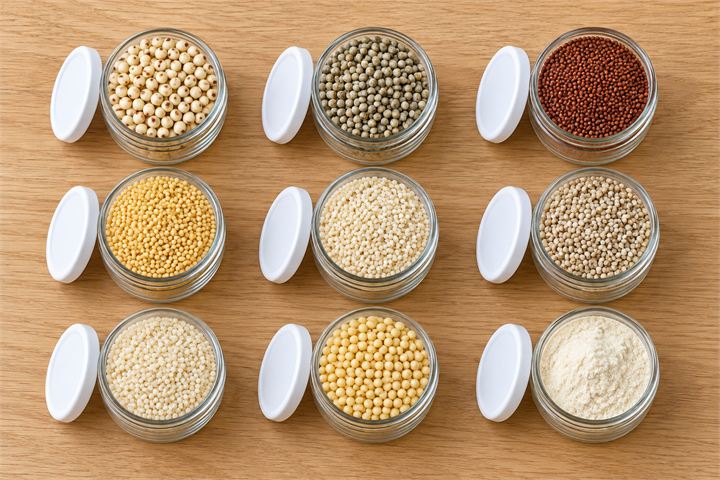
Eight millet grains and a millet flour, from processors we select and check. The story of millets is told once, here; each grain has its own page with its grade and specification.
Millets are small-seeded grasses, and they are among the first grains people ever farmed. Proso and foxtail millet were grown in northern China more than eight thousand years ago. Sorghum, pearl millet and finger millet were first farmed in Africa and reached India thousands of years ago. Little millet and kodo millet were first farmed in India itself. At Harappan sites in western India, archaeologists have found millet grains more than four thousand years old, and early Sanskrit texts list them among the grains of the field: priyangu, foxtail millet, and shyamaka, barnyard millet.
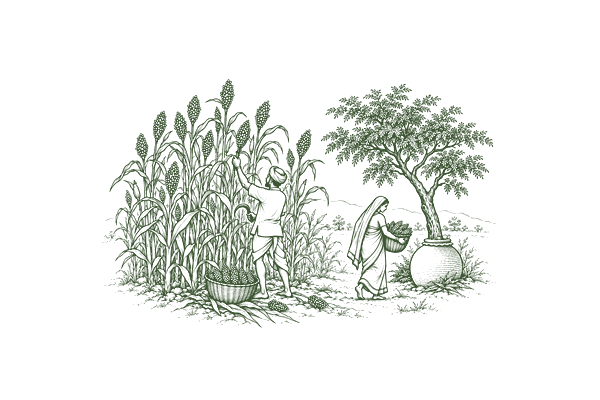
For most of India's history, millets were the everyday grain of the dry country: the Deccan plateau, Rajasthan, and the hill and forest villages. Smallholders grew them, often alongside pulses, and ate them every day. In Maharashtra, where we are based, jowar and bajra bhakri are still the daily flatbread in many homes. In Karnataka, ragi is cooked into mudde and eaten with saaru. In Rajasthan and Gujarat, bajra roti is a staple. In the hills, kodo and little millet are cooked whole, like rice.
Most of India's millets are grown without irrigation, on rain alone, often on light soils where rice and wheat would need far more water. They tolerate heat and dry spells, and some, such as proso and barnyard millet, are ready to harvest in three months or less. That made them a crop farmers could rely on when the monsoon was uncertain. It is also why agricultural researchers and governments are looking at them again, as farming adapts to hotter, drier seasons.
In the second half of the twentieth century, rice and wheat took the place of millets on many Indian plates. The return began at home: India proposed, and the United Nations declared, 2023 the International Year of Millets. India grows more millet than any other country, and food makers abroad now use millet grains and flours in breads, crackers, porridges, breakfast cereals and snacks. This shelf carries eight grains (jowar, bajra, ragi, foxtail, little, kodo, barnyard and proso millet) and a millet flour. A sample comes before the quotation.
Add any of them to your quote list; one request covers products from both brands.
MilletsGrade, origin, pack and MOQ come on the specification we send with each quotation.
MilletsGrade, origin, pack and MOQ come on the specification we send with each quotation.
MilletsGrade, origin, pack and MOQ come on the specification we send with each quotation.
MilletsGrade, origin, pack and MOQ come on the specification we send with each quotation.
MilletsGrade, origin, pack and MOQ come on the specification we send with each quotation.
MilletsGrade, origin, pack and MOQ come on the specification we send with each quotation.
MilletsGrade, origin, pack and MOQ come on the specification we send with each quotation.
MilletsGrade, origin, pack and MOQ come on the specification we send with each quotation.
MilletsGrade, origin, pack and MOQ come on the specification we send with each quotation.
Tell us what you need, where it is going and roughly how much. One of the directors replies with a specification and a quotation on your terms.